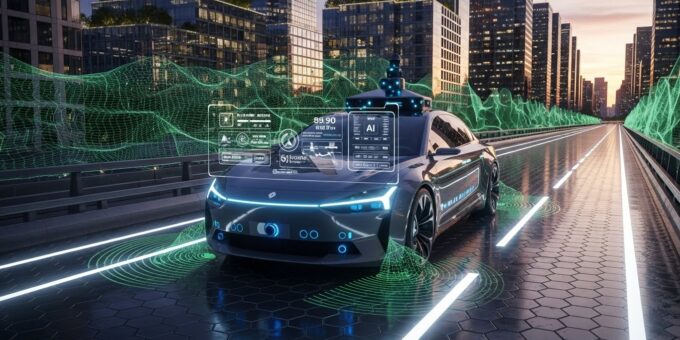
Introduction to How Self-Driving Cars Work
How self-driving cars work is one of the most searched questions in modern automotive technology. Autonomous vehicles are no longer science fiction. They are already operating on public roads in many countries. Powered by artificial intelligence, advanced sensors, and real-time data processing, self-driving cars aim to reduce accidents, improve traffic flow, and reshape mobility.
This guide explains the core self-driving car technology, how safety systems function, and the latest legal updates shaping the future of autonomous vehicles.
What Are Self-Driving Cars?
Self-driving cars, also called autonomous vehicles, are cars capable of sensing their environment and operating without human intervention. These vehicles rely on software-driven decision-making rather than manual control.
Levels of Driving Automation
The Society of Automotive Engineers (SAE) defines six levels of automation:
Level 0: No automation, fully human-driven.
Level 1: Driver assistance such as adaptive cruise control.
Level 2: Partial automation like lane keeping and braking.
Level 3: Conditional automation under specific conditions.
Level 4: High automation in limited areas.
Level 5: Full automation with no driver required.
Core Technology Behind Self-Driving Cars
Understanding how self-driving cars work starts with the core technologies that allow vehicles to perceive, analyze, and act.
Sensors and Hardware Systems
Self-driving cars use multiple sensors to create a 360-degree view of their surroundings.
LiDAR: Uses laser pulses to measure distances and create 3D maps.
Radar: Detects speed and distance of objects, especially in bad weather.
Cameras: Recognize traffic signs, lanes, pedestrians, and signals.
Ultrasonic sensors: Assist with short-range detection.
Artificial Intelligence and Machine Learning
AI is the brain behind autonomous vehicles. Machine learning models analyze sensor data, predict behavior, and make driving decisions in milliseconds.
Just like building an online business, self-driving systems continuously learn from massive data sets. This ongoing learning process improves accuracy and reliability over time.
High-Definition Maps and GPS
HD maps provide precise road details including lane markings, traffic lights, and curbs. GPS enhances positioning accuracy, ensuring vehicles stay within safe boundaries.
How Self-Driving Cars Make Decisions
Decision-making is the most complex part of how self-driving cars work. The system follows a three-step process.
Perception
The vehicle identifies objects, road conditions, and obstacles using sensor fusion.
Prediction
The system predicts how surrounding vehicles, cyclists, and pedestrians will behave.
Planning and Control
Algorithms calculate the safest path and send commands to steering, braking, and acceleration systems.
Safety Systems in Self-Driving Cars
Safety is the top priority for autonomous vehicle developers.
Redundancy and Fail-Safe Design
Critical systems have backups. If one sensor fails, others take over.
Collision Avoidance Technology
Advanced braking, emergency steering, and obstacle detection reduce crash risks.
Human Override Capabilities
Most current self-driving cars allow drivers to take control instantly if needed.
Much like managing passive income streams, autonomous driving systems aim to minimize human effort while maintaining control and safety.
Cybersecurity and Data Protection
As vehicles become more connected, cybersecurity is essential. Manufacturers encrypt data, secure communication channels, and update software remotely to prevent hacking.
Legal and Regulatory Updates in 2026
Legal frameworks are evolving alongside self-driving technology.
Global Regulations
Countries like the US, Germany, Japan, and Singapore allow limited Level 4 autonomous testing under strict rules.
Liability and Insurance
Liability is shifting from drivers to manufacturers and software providers. Insurance models now consider system faults and software updates.
Data and Privacy Laws
Governments require transparent data usage and compliance with privacy regulations.
Benefits of Self-Driving Cars
Autonomous vehicles offer significant advantages.
Reduced accidents: Human error causes most crashes.
Improved traffic efficiency: AI-driven routing reduces congestion.
Accessibility: Enhances mobility for elderly and disabled users.
Like affiliate marketing and the dropshipping business, self-driving technology represents a scalable innovation that can disrupt entire industries.
Challenges Facing Autonomous Vehicles
Despite rapid progress, challenges remain.
Technical Limitations
Extreme weather and complex urban environments still pose difficulties.
Public Trust
Widespread adoption depends on consumer confidence and proven safety records.
Ethical Decision-Making
Programming ethical responses in unavoidable crash scenarios remains controversial.
The Business Side of Self-Driving Cars
Autonomous driving is creating new business models.
Ride-hailing services, logistics automation, and smart city integration are growing rapidly. Similar to comparing affiliate vs dropshipping, companies must choose the right strategy to scale profitably.
Future of Self-Driving Cars
The future of autonomous vehicles looks promising. By 2030, experts expect widespread Level 4 adoption in urban zones.
Continuous AI improvements, supportive laws, and infrastructure upgrades will accelerate adoption. Understanding how self-driving cars work today prepares consumers and investors for tomorrow’s mobility revolution.
Conclusion
Self-driving cars combine AI, sensors, and real-time data to deliver safer and smarter transportation. While challenges remain, legal updates and technological breakthroughs are pushing the industry forward.
As with any emerging online business opportunity, early adoption and awareness can offer long-term advantages. Autonomous vehicles are not just changing how we drive, but how we live.
